← View series: ibm ai engineering
~/blog
Multiple Linear Regression Training

Linear Regression Multiple Outputs
Objective
- How to create a complicated models using PyTorch build in functions.
Table of Contents
In this lab, you will create a model the PyTorch way. This will help you more complicated models.
- Make Some Data
- Create the Model and Cost Function the PyTorch way
- Train the Model: Batch Gradient Descent
Estimated Time Needed: 20 min
Preparation
We'll need the following libraries:
# Import the libraries we need for this lab

from torch import nn,optim
import torch
import numpy as np
import matplotlib.pyplot as plt

from mpl_toolkits.mplot3d import Axes3D
from torch.utils.data import Dataset, DataLoader
import warnings

# Suppress all warnings
warnings.filterwarnings("ignore")
Set the random seed:
# Set the random seed to 1.

torch.manual_seed(1)
Use this function for plotting:
# The function for plotting 2D

def Plot_2D_Plane(model, dataset, n=0):
    w1 = model.state_dict()['linear.weight'].numpy()[0][0]
    w2 = model.state_dict()['linear.weight'].numpy()[0][1]
    b = model.state_dict()['linear.bias'].numpy()

    # Data
    x1 = dataset.x[:, 0].view(-1, 1).numpy()
    x2 = dataset.x[:, 1].view(-1, 1).numpy()
    y = dataset.y.numpy()

    # Make plane
    X, Y = np.meshgrid(np.arange(x1.min(), x1.max(), 0.05), np.arange(x2.min(), x2.max(), 0.05))
    yhat = w1 * X + w2 * Y + b

    # Plotting
    fig = plt.figure()
    ax = fig.gca(projection='3d')

    ax.plot(x1[:, 0], x2[:, 0], y[:, 0],'ro', label='y') # Scatter plot

    ax.plot_surface(X, Y, yhat) # Plane plot

    ax.set_xlabel('x1 ')
    ax.set_ylabel('x2 ')
    ax.set_zlabel('y')
    plt.title('estimated plane iteration:' + str(n))
    ax.legend()

    plt.show()
Make Some Data
Create a dataset class with two-dimensional features:
# Create a 2D dataset

class Data2D(Dataset):

    # Constructor
    def __init__(self):
        self.x = torch.zeros(20, 2)
        self.x[:, 0] = torch.arange(-1, 1, 0.1)
        self.x[:, 1] = torch.arange(-1, 1, 0.1)
        self.w = torch.tensor([[1.0], [1.0]])
        self.b = 1
        self.f = torch.mm(self.x, self.w) + self.b
        self.y = self.f + 0.1 * torch.randn((self.x.shape[0],1))
        self.len = self.x.shape[0]

    # Getter
    def __getitem__(self, index):
        return self.x[index], self.y[index]

    # Get Length
    def __len__(self):
        return self.len
Create a dataset object:
# Create the dataset object

data_set = Data2D()
Create the Model, Optimizer, and Total Loss Function (Cost)
Create a customized linear regression module:
# Create a customized linear

class linear_regression(nn.Module):

    # Constructor
    def __init__(self, input_size, output_size):
        super(linear_regression, self).__init__()
        self.linear = nn.Linear(input_size, output_size)

    # Prediction
    def forward(self, x):
        yhat = self.linear(x)
        return yhat
Create a model. Use two features: make the input size 2 and the output size 1:
# Create the linear regression model and print the parameters

model = linear_regression(2,1)
print("The parameters: ", list(model.parameters()))
Create an optimizer object. Set the learning rate to 0.1. Don't forget to enter the model parameters in the constructor.
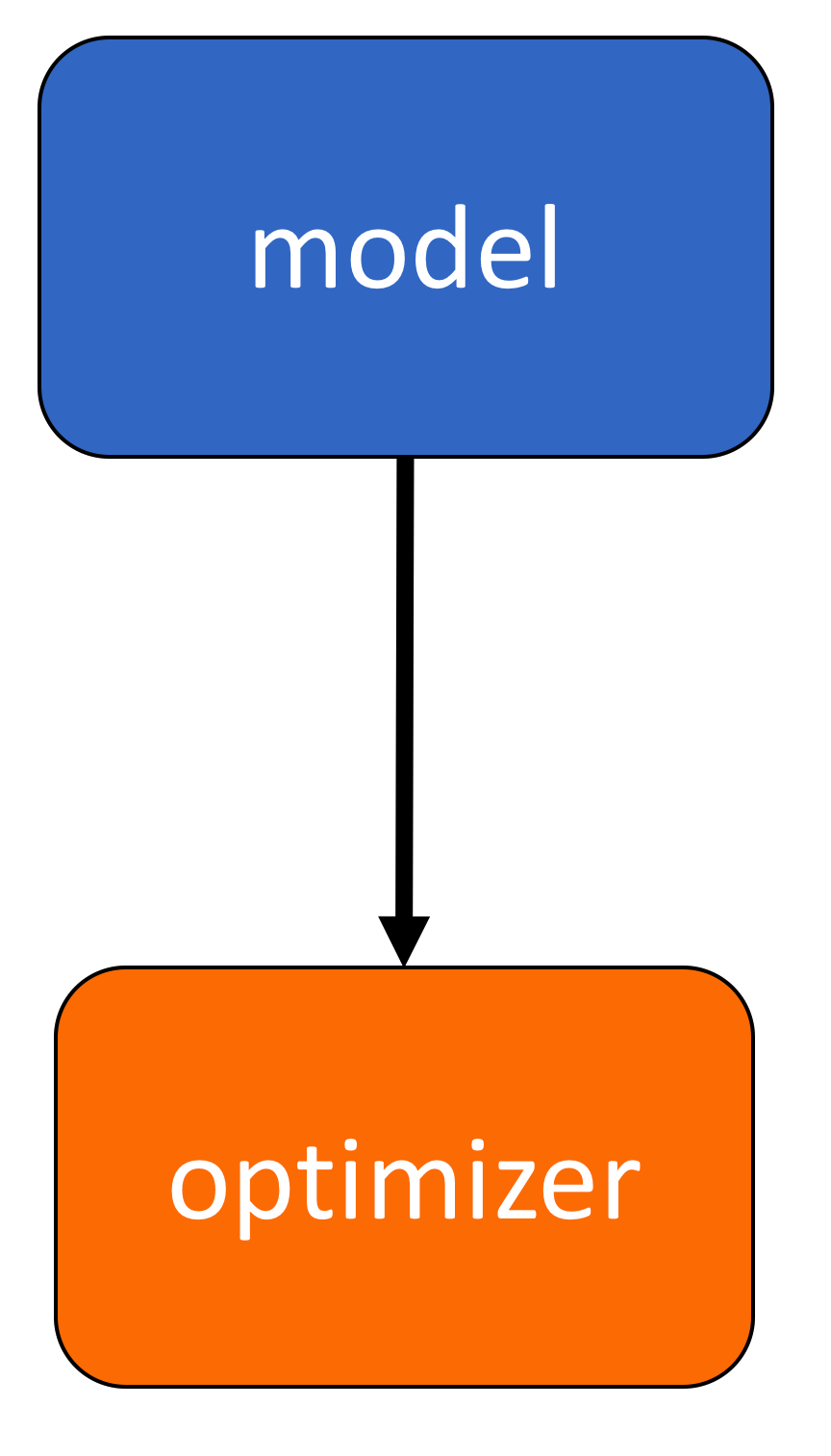 How the optimizer works
# Create the optimizer

optimizer = optim.SGD(model.parameters(), lr=0.1)
Create the criterion function that calculates the total loss or cost:
# Create the cost function

criterion = nn.MSELoss()
Create a data loader object. Set the batch_size equal to 2:
# Create the data loader

train_loader = DataLoader(dataset=data_set, batch_size=2)
Train the Model via Mini-Batch Gradient Descent
Run 100 epochs of Mini-Batch Gradient Descent and store the total loss or cost for every iteration. Remember that this is an approximation of the true total loss or cost:
# Train the model

LOSS = []
print("Before Training: ")
Plot_2D_Plane(model, data_set)
epochs = 100

def train_model(epochs):
    for epoch in range(epochs):
        for x,y in train_loader:
            yhat = model(x)
            loss = criterion(yhat, y)
            LOSS.append(loss.item())
            optimizer.zero_grad()
            loss.backward()
            optimizer.step()
train_model(epochs)
print("After Training: ")
Plot_2D_Plane(model, data_set, epochs)# Plot out the Loss and iteration diagram
plt.plot(LOSS)
plt.xlabel("Iterations ")
plt.ylabel("Cost/total loss ")Practice
Create a new model1. Train the model with a batch size 10 and learning rate 0.1, store the loss or total cost in a list LOSS1, and plot the results.
# Practice create model1. Train the model with batch size 10 and learning rate 0.1, store the loss in a list <code>LOSS1</code>. Plot the results.

data_set = Data2D()
Double-click here for the solution.
Use the following validation data to calculate the total loss or cost for both models:
torch.manual_seed(2)

validation_data = Data2D()
Y = validation_data.y
X = validation_data.x
Double-click here for the solution.

About the Authors:
Joseph Santarcangelo has a PhD in Electrical Engineering, his research focused on using machine learning, signal processing, and computer vision to determine how videos impact human cognition. Joseph has been working for IBM since he completed his PhD.
Other contributors: Michelle Carey, Mavis Zhou