← View series: ibm ai engineering
~/blog
Multiple Linear Regression Prediction

Multiple Linear Regression
Objective
- How to make the prediction for multiple inputs.
- How to use linear class to build more complex models.
- How to build a custom module.
Table of Contents
In this lab, you will review how to make a prediction in several different ways by using PyTorch.
Preparation
Import the libraries and set the random seed.
# Import the libraries and set the random seed

from torch import nn
import torch
torch.manual_seed(1)
Prediction
Set weight and bias.
# Set the weight and bias

w = torch.tensor([[2.0], [3.0]], requires_grad=True)
b = torch.tensor([[1.0]], requires_grad=True)
Define the parameters. torch.mm uses matrix multiplication instead of scaler multiplication.
# Define Prediction Function

def forward(x):
    yhat = torch.mm(x, w) + b
    return yhat
The function forward implements the following equation:
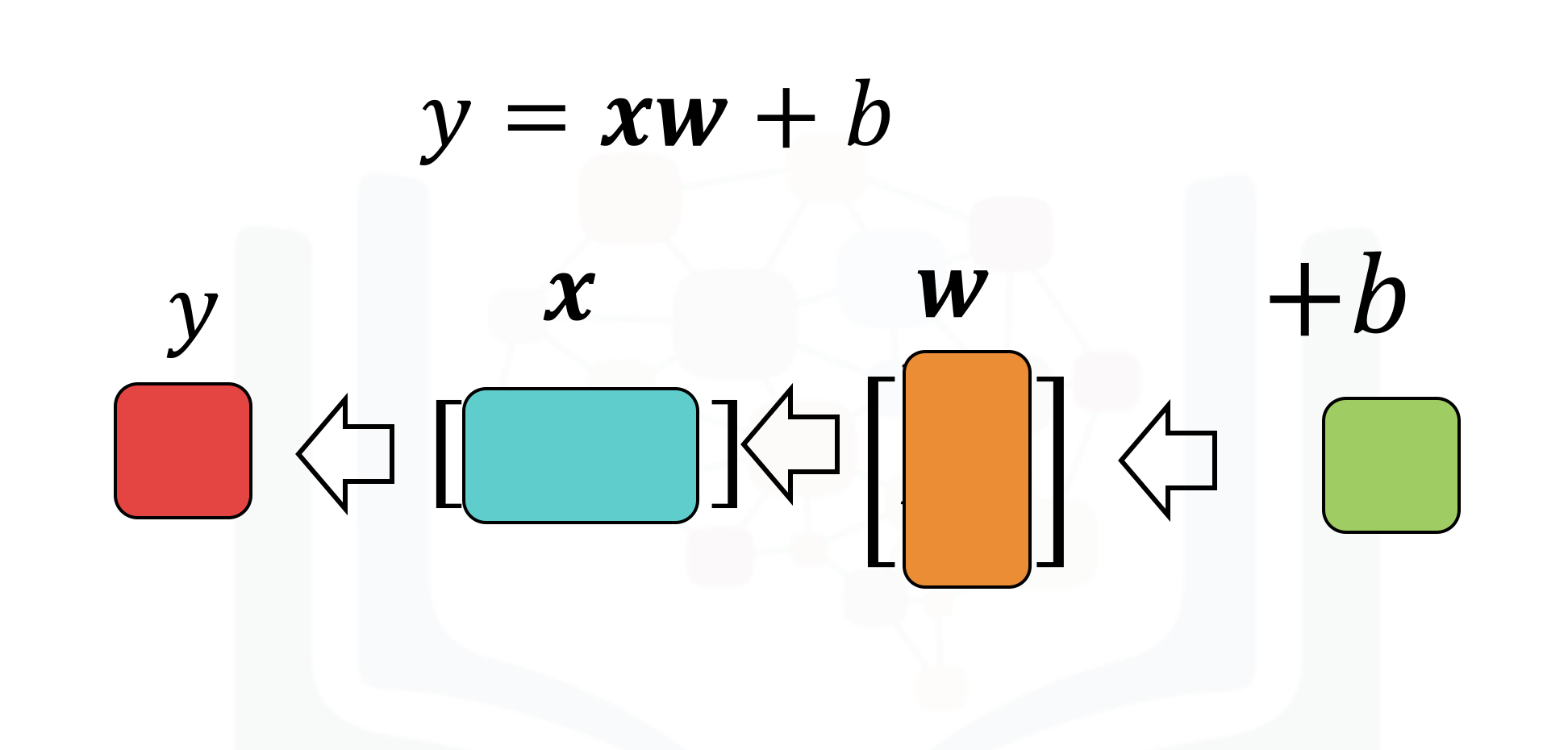 Matrix Linear Regression
If we input a 1x2 tensor, because we have a 2x1 tensor as w, we will get a 1x1 tensor:
# Calculate yhat
x = torch.tensor([[1.0, 2.0]])
yhat = forward(x)
print("The result: ", yhat)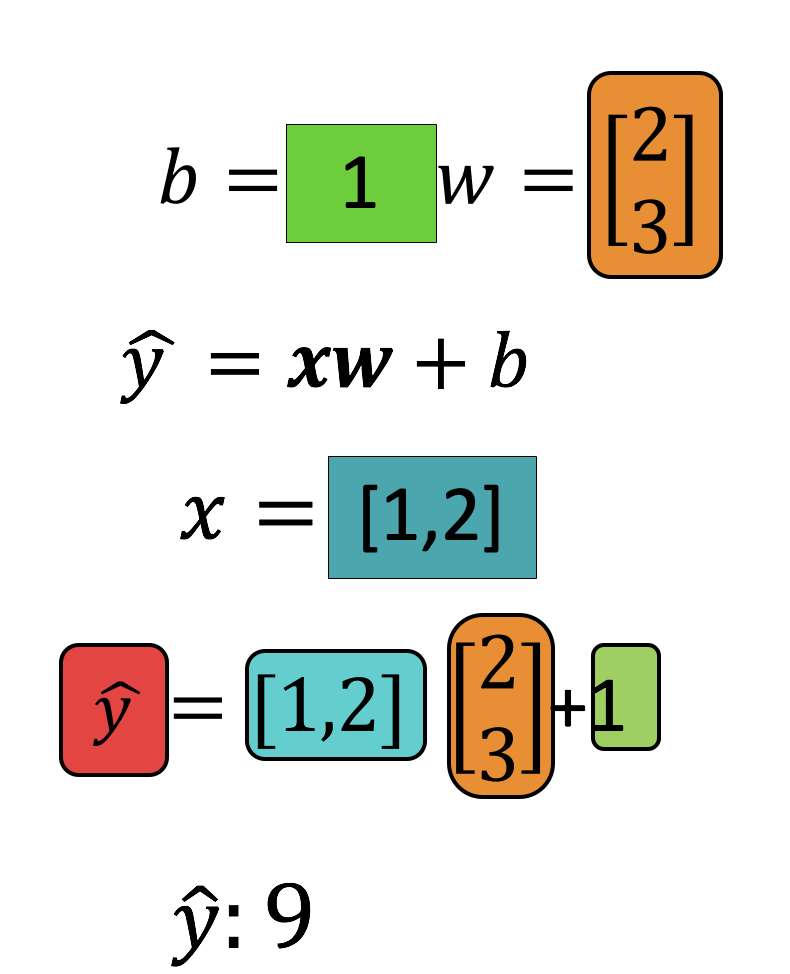 Linear Regression Matrix Sample One
Each row of the following tensor represents a sample:
# Sample tensor X

X = torch.tensor([[1.0, 1.0], [1.0, 2.0], [1.0, 3.0]])# Make the prediction of X
yhat = forward(X)
print("The result: ", yhat)Class Linear
We can use the linear class to make a prediction. You'll also use the linear class to build more complex models.
Let us create a model.
# Make a linear regression model using build-in function

model = nn.Linear(2, 1)
Make a prediction with the first sample:
# Make a prediction of x

yhat = model(x)
print("The result: ", yhat)
Predict with multiple samples X:
# Make a prediction of X

yhat = model(X)
print("The result: ", yhat)
The function performs matrix multiplication as shown in this image:
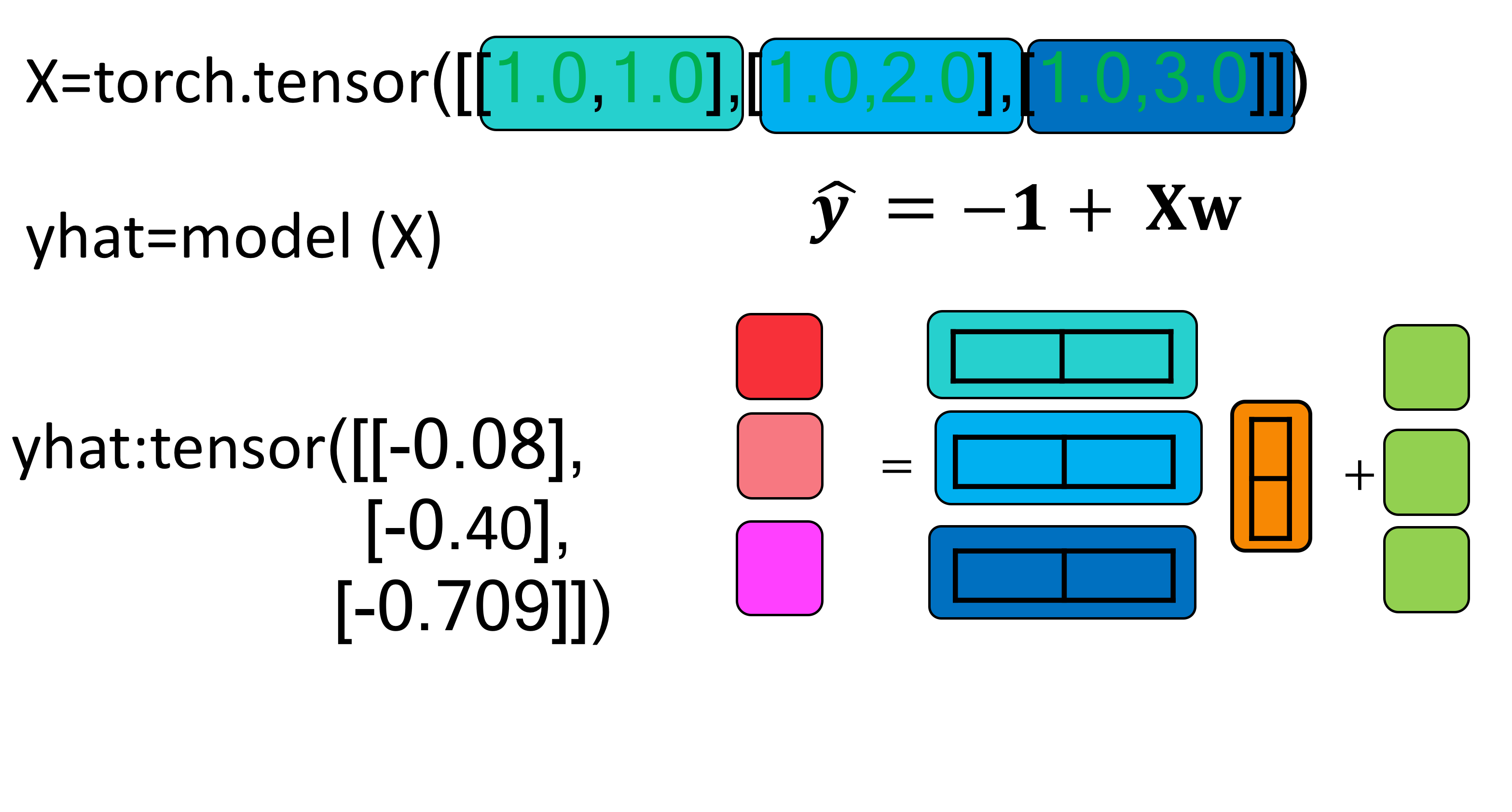 Linear Regression Matrix Sample One
Build Custom Modules
Now, you'll build a custom module. You can make more complex models by using this method later.
# Create linear_regression Class

class linear_regression(nn.Module):

    # Constructor
    def __init__(self, input_size, output_size):
        super(linear_regression, self).__init__()
        self.linear = nn.Linear(input_size, output_size)

    # Prediction function
    def forward(self, x):
        yhat = self.linear(x)
        return yhat
Build a linear regression object. The input feature size is two.
model = linear_regression(2, 1)This will input the following equation:
Matrix Linear Regression
You can see the randomly initialized parameters by using the parameters() method:
# Print model parameters

print("The parameters: ", list(model.parameters()))
You can also see the parameters by using the state_dict() method:
# Print model parameters

print("The parameters: ", model.state_dict())
Now we input a 1x2 tensor, and we will get a 1x1 tensor.
# Make a prediction of x

yhat = model(x)
print("The result: ", yhat)
The shape of the output is shown in the following image:
Matrix Linear Regression
Make a prediction for multiple samples:
# Make a prediction of X

yhat = model(X)
print("The result: ", yhat)
The shape is shown in the following image:
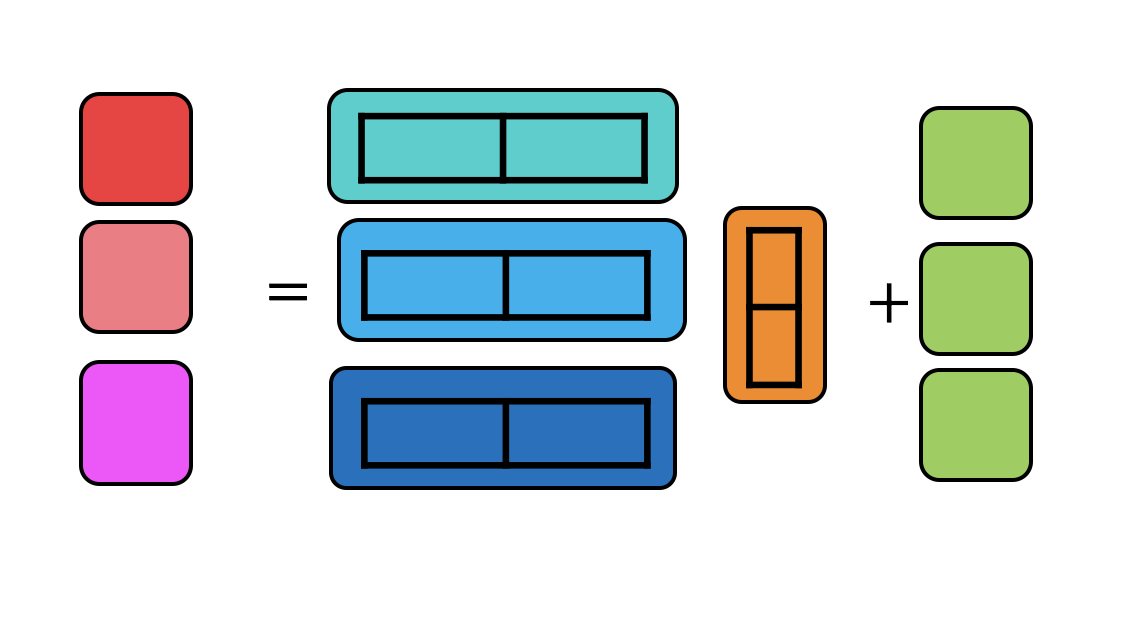 Multiple Samples Linear Regression
Practice
Build a model or object of type linear_regression. Using the linear_regression object will predict the following tensor:
# Practice: Build a model to predict the follow tensor.

X = torch.tensor([[11.0, 12.0, 13, 14], [11, 12, 13, 14]])
Double-click here for the solution.

About the Authors:
Joseph Santarcangelo has a PhD in Electrical Engineering, his research focused on using machine learning, signal processing, and computer vision to determine how videos impact human cognition. Joseph has been working for IBM since he completed his PhD.
Other contributors: Michelle Carey, Mavis Zhou