~/blog
The Four Trade-offs Every Agent System Forces You to Make
Every agent system you ship is a set of negotiated compromises. The moment you deploy, you've already chosen what to sacrifice — even if you didn't know you were choosing.
I've been deep in multi-agent systems lately — reading Victor Dibia's Designing Multi-Agent Systems alongside Chip Huyen's AI Engineering — and one thing keeps surfacing: most teams fail not because they chose the wrong model, but because they didn't consciously manage the four core trade-offs. They optimised for one dimension and got blindsided by the others.
This post breaks down those four trade-offs — performance, scalability, reliability, and cost — with the mental models you need to make good decisions before you're in production firefighting mode.
01. Performance: Speed vs. Accuracy
This is the most visible trade-off and the one engineers reach for first. The question isn't "how do I make my agent faster?" — it's "how fast does it actually need to be, and what accuracy can I afford to trade away at that speed?"
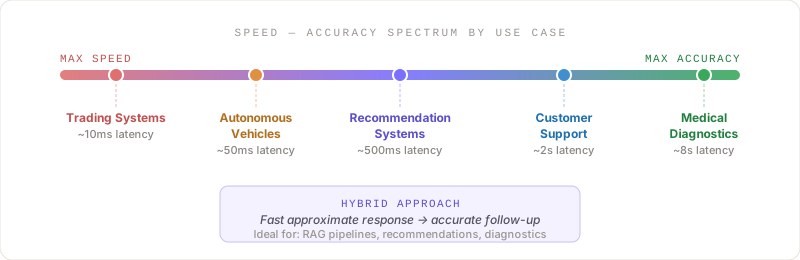
In real-time environments — trading systems, autonomous vehicles — milliseconds are critical. Speed wins. In medical diagnostics or legal analysis, precision is non-negotiable. Accuracy wins. The interesting territory is the middle: recommendation systems, customer support agents, RAG pipelines. This is where most production agents live.
The under-used pattern here is the two-phase hybrid: a lightweight model fires first and returns a rough answer, then a heavier model refines it asynchronously. RAG pipelines do this naturally — retrieve fast, generate slow. The mistake is treating this as a workaround when it should be your default architecture for most non-trivial agents.
The real question: What is the cost of a wrong answer vs. the cost of a slow answer in your specific domain? That ratio determines where you sit on this spectrum — not benchmarks.
02. Scalability: Engineering for Growth
Scalability in agent systems is more brutal than in traditional software. You're not just handling more HTTP requests — you're handling more inference calls, more GPU time, more context windows, more tool invocations. The cost curve isn't linear; it bends.
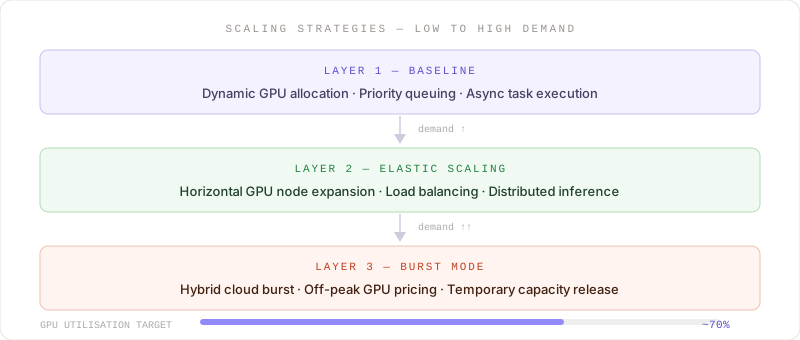
The key insight is that you should never plan to scale by just "adding more GPUs." That's the equivalent of throwing money at a poorly written SQL query. The architecture needs to be designed for parallelism from day one — asynchronous task queues, distributed inference, and intelligent scheduling.
Three scaling layers to architect for
Layer 1 — Baseline: Dynamic GPU allocation based on real-time demand, priority queuing so high-value tasks don't wait, and async task execution to prevent idle time between operations.
Layer 2 — Elastic scaling: Horizontal expansion with additional GPU nodes, load balancing to prevent any single node becoming a bottleneck, and distributed inference for heavy workloads.
Layer 3 — Burst mode: Hybrid on-prem + cloud GPU strategy. Use on-prem for stable baseline load, burst to cloud during peak demand, and critically — release those cloud resources when demand drops. Teams that treat cloud GPUs as permanent fixtures burn budget fast.
Using cloud GPU instances during off-peak hours, when pricing is lower, can significantly reduce operational costs while maintaining burst capacity when needed.
03. Reliability: Consistent Behaviour Under Pressure
Reliability is the trade-off that bites you last — but when it does, it bites hard. An agent that works 99% of the time in dev fails in ways you didn't predict in prod. Safety-critical systems — medical agents, autonomous systems, financial execution — have zero tolerance here.
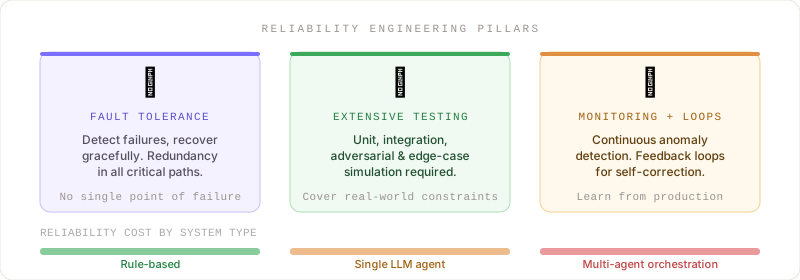
The three non-negotiables
Fault tolerance means building systems that degrade gracefully rather than fail catastrophically. Network interruptions, hardware failures, and model timeouts should trigger fallback paths, not crashes. Redundancy in critical components is mandatory — not a nice-to-have.
Extensive testing goes well beyond unit tests. Agents need to be tested against edge cases, adversarial inputs, unexpected sequences of tool calls, and real-world constraints. Simulating production environments before you're in them is the highest-leverage reliability investment you can make.
Monitoring and feedback loops keep production agents improving. Continuous anomaly detection surfaces degradation before users do. Feedback loops allow agents to learn from failures and adjust behaviour over time.
The hardest reliability problem in multi-agent systems isn't individual agent failure — it's emergent failure when agents interact. An orchestrator that works perfectly with Agent A and Agent B individually can produce nonsense when they collaborate under certain inputs. Adversarial testing and simulation environments aren't optional for these systems; they're load-bearing.
Practical heuristic: Treat every tool call your agent makes as a potential failure point. Build retry logic, fallback behaviours, and output validation at every boundary. The agent shouldn't assume its tools are reliable — they aren't.
04. Cost: Where the Budget Actually Goes
Cost is the trade-off teams underestimate during design and over-panic about during operation. The numbers are real but manageable — if you bake cost thinking in from the start rather than retrofitting it after the bill arrives.
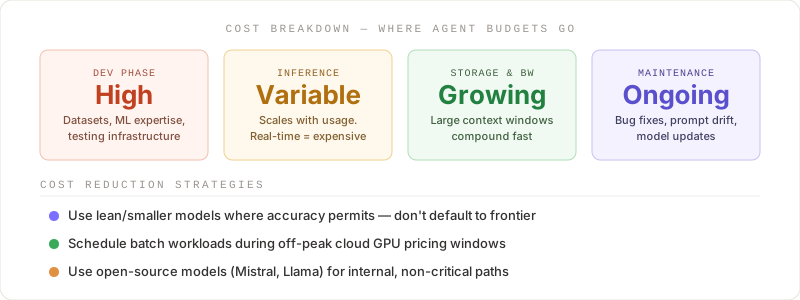
Development costs
Building sophisticated agents is expensive. Large datasets, specialised ML expertise, iterative design cycles, and testing infrastructure all add up before you've written a single production inference call. Teams with unrealistic dev-phase budgets end up skipping the testing infrastructure — which they pay for in reliability incidents later.
Operational costs
After deployment, the costs don't stop. Deep learning models running real-time inference are computationally expensive. Agents that maintain large context windows or process high data volumes incur significant storage and bandwidth costs. Regular maintenance — bug fixes, prompt drift corrections, model updates — requires ongoing engineering time.
Three strategies that actually move the needle
-
Use lean models where appropriate. A rule-based system or a smaller fine-tuned model will often achieve comparable results to a frontier model for narrow, well-defined tasks — at a fraction of the inference cost. Don't default to the biggest model available by habit.
-
Schedule non-latency-sensitive workloads off-peak. Cloud GPU pricing varies significantly by time of day and region. Batch processing, retraining runs, and evaluation pipelines don't need to run during peak hours. This is surprisingly impactful at scale.
-
Use open-source models for non-critical paths. Use frontier API models where quality is mission-critical. Use open-source models (Mistral, Llama, etc.) for internal tooling, evaluation, summarisation, and any path where absolute accuracy isn't the constraint.
05. The Whole Picture
These trade-offs don't exist in isolation. Every decision you make on one dimension ripples into the others. Higher accuracy requires more compute — which impacts cost. Better reliability requires more testing infrastructure — which impacts dev time. Scaling aggressively without reliability engineering in place is how you end up with a fast, expensive, unreliable system.
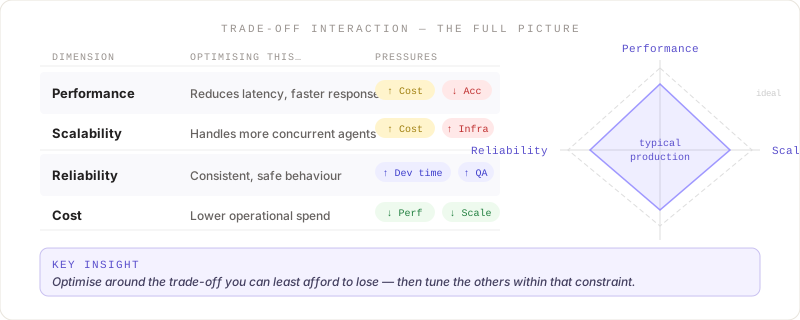
The goal isn't to maximise all four simultaneously — that's not achievable within any real budget. The goal is to know, consciously, which one you're sacrificing and why, and to build the system with that decision visible in the architecture.
The teams that get this right don't stumble into good agent systems. They draw the trade-off map before writing a single line of code. They revisit it when the system misbehaves. And they make sure every stakeholder understands that every "faster" request is also a "less accurate" or "more expensive" request in disguise.
If I had to distil it: Design your agent system around the trade-off you can least afford to lose — then systematically optimise the others within that constraint. Everything else is tuning.